C’est parti pour la mise à jour de l’Article n°13.
C’est un sujet d’actualité bouillant qui est passé de la science-fiction à la réalité en quelques mois (avec l’arrivée de Sora, Runway, etc.). Ce guide doit être futuriste et pratique pour les marketeurs.
Voici la Version 2.0 (Longue Forme – 1800+ mots).
📝 Instructions de Mise à Jour
- Va dans ton admin WordPress > Posts (Articles).
- Ouvre l’article “Using Generative AI for Video Content Production: A Beginner’s Guide”.
- Efface tout le texte actuel.
- Copie et colle ce nouveau contenu complet ci-dessous.
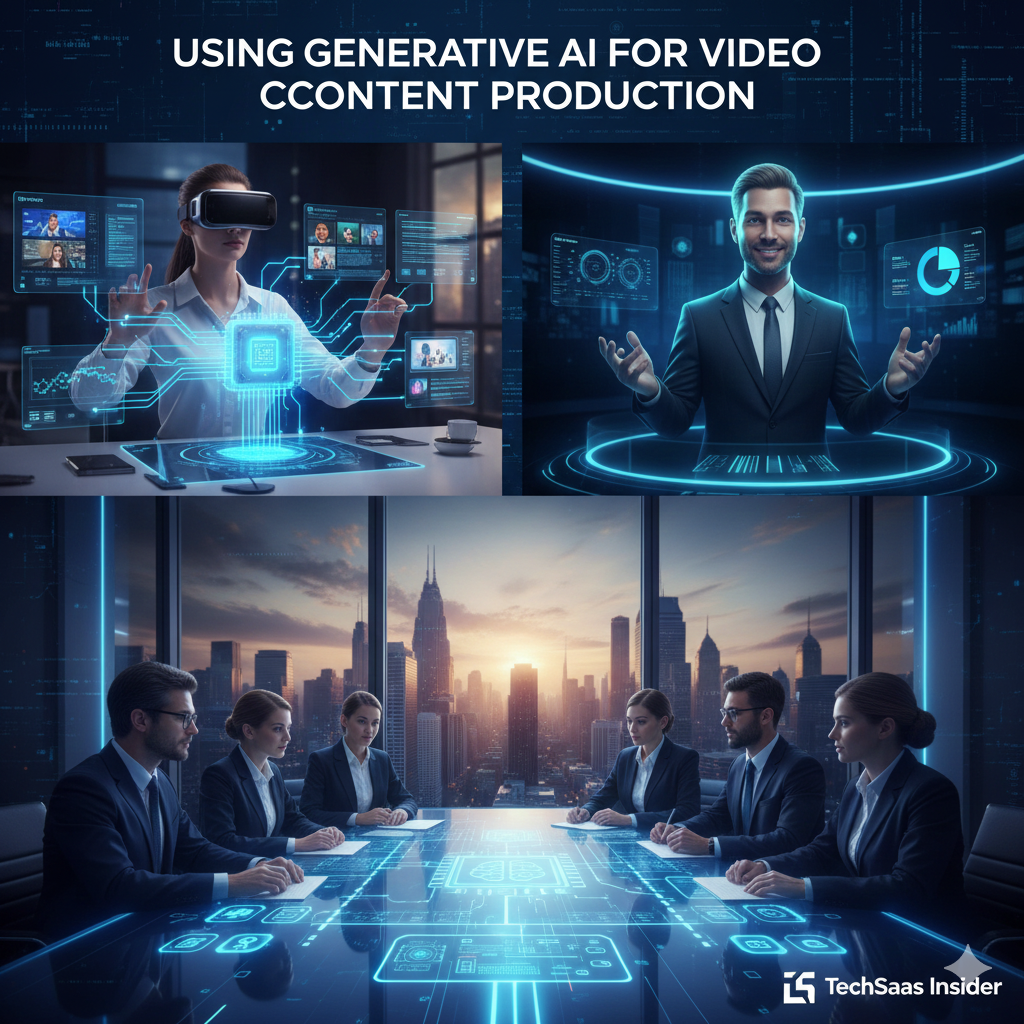
Using Generative AI for Video Content Production: From Script to Screen in Minutes (2025 Guide)
Video content dominates the digital landscape. Whether it’s a short-form Reel, a YouTube explainer, or a corporate training module, video commands more attention and conversion than any other medium. Yet, traditional video production remains prohibitively expensive, time-consuming, and resource-intensive, requiring cameras, studios, editing software, and specialized staff.
In 2025, Generative AI is dismantling this barrier.
No longer relegated to sci-fi films, Text-to-Video (TTV) models like OpenAI’s Sora and Runway’s Gen-3 are revolutionizing the creative process. They allow anyone—from a solo consultant to a large marketing team—to create professional-grade video content with the simple input of a text prompt.
This comprehensive guide serves as your roadmap to the AI video revolution. We break down the technology, review the most powerful practical SaaS tools available today (Synthesia, Pictory, Descript), and outline the strategic use cases that will turn video production from a bottleneck into a competitive advantage.
1. The Bottlenecks AI Solves in Video Production
The high cost of video production is primarily due to three factors that generative AI eliminates:
1. Cost of Talent and Equipment
- Old Way: Paying actors, camera operators, renting studio space, and buying thousands of dollars worth of lighting and audio gear.
- AI Way: Using an AI-generated Avatar (presenter) that is always available, never charges residual fees, and speaks 50 languages perfectly.
2. Time Sink of Editing and Rendering
- Old Way: Hours spent sifting through footage, color correcting, adding motion graphics, and waiting for final exports.
- AI Way: Editing a video by simply editing the script (Descript). Generating 30-second commercial variations from a text prompt in minutes (Runway).
3. The Skill Barrier (The New “Digital Literacy”)
- Old Way: Requires mastery of complex software (Adobe Premiere, After Effects).
- AI Way: The primary skill is Prompt Engineering—telling the AI exactly what you want to see. The user interface is the text box.
2. The Technology Behind the Magic (Text-to-Video)
The AI video revolution is built on the same foundation as image generators (DALL-E, Midjourney): Diffusion Models.
How It Works: Creating Motion from Text
When you type a prompt (“A vintage 1950s robot walking down a New York street in the snow”), the TTV model does three things:
- Interpretation: The AI breaks the prompt down into concepts (robot, snow, street, time of day).
- Synthesis: It uses its massive training data (billions of video clips) to generate a sequence of still frames based on the prompt’s concepts.
- Consistency: It uses diffusion techniques to ensure that the robot maintains its physical form and the snow falls naturally across every frame, creating smooth, realistic motion.
The goal is coherence. The speed and quality of motion coherence are the metrics that define the new generation of TTV models (Sora, Luma AI).
3. Essential AI Tools for Business Video (The Practical Stack)
While TTV models are great for cinematic work, businesses need specialized SaaS tools for daily content.
1. Synthesia / HeyGen (The Avatar Presenters)
- Core Use Case: Corporate communication, training videos, and explainers.
- How they Work: You type your script, select a photorealistic or animated avatar from their library, and choose a voice (or clone your own). The AI syncs the avatar’s lips and facial expressions perfectly to your script.
- Business Benefit: Massive cost savings on hiring spokespeople or filming compliance videos. You can update a regulatory training video in 5 minutes by simply editing the script, not refilming.
- Best For: HR, L&D (Learning and Development), and Sales Demos.
2. Pictory / Lumen5 (The Repurposing Engines)
- Core Use Case: Converting long-form content (blogs, whitepapers, podcasts) into short-form video.
- How they Work: You paste the URL of a blog post. The AI scans the text, identifies key sentences, selects relevant stock video/images, adds background music, and generates synchronized captions.
- Business Benefit: Solves the problem of “omnichannel distribution.” A single blog post can be instantly turned into 10 separate social media videos.
- Best For: Content marketers and SEO teams needing to scale video output without a production team.
3. Descript (The “Word Processor” for Video)
- Core Use Case: Editing spoken-word video (podcasts, tutorials, interviews).
- How it Works: Descript transcribes your video instantly. To edit, you simply delete the text in the transcript. The corresponding audio and video clips are removed automatically.
- The AI Edge:
- Studio Sound: Removes echo and background noise with one click.
- Overdub: Allows you to type new words, and the AI will generate the audio in the original speaker’s voice, allowing you to correct mistakes without re-recording.
- Best For: YouTubers, educators, and anyone who struggles with traditional NLE (Non-Linear Editing) software.
4. Runway (The Generative Artist)
- Core Use Case: Creating unique video assets, B-roll, and concept visualizations.
- How it Works: Runway’s Gen-2/Gen-3 models allow you to generate video from a text prompt or transform existing footage (e.g., turning a simple cell phone clip into a hyper-realistic cinematic shot).
- Business Benefit: Eliminates the need for expensive stock footage licenses or complex CGI for simple commercial concepts.
- Best For: Creative agencies and product designers needing to rapidly prototype video concepts.
4. Ethical & Strategic Challenges in AI Video
The technology is powerful, but ethical and legal challenges remain critical.
The Uncanny Valley & Authenticity
While AI avatars are impressive, they can still sometimes look “off” or fall into the Uncanny Valley (a feeling of discomfort). For high-trust communication (e.g., a CEO address), human filming may still be required.
Deepfakes and Trust
The ability to generate realistic videos instantly poses a threat of misuse (deepfakes). Businesses must ensure they are using platforms with strong governance. When using an AI avatar, best practice dictates transparent labeling (“This video features an AI presenter”).
Copyright and IP
If the AI generates a video that looks similar to a copyrighted movie, who is responsible? Most commercial AI platforms (Synthesia, Pictory) guarantee that the assets they generate (stock footage, music, avatars) are commercially licensed or unique, mitigating risk.
5. The Hybrid Workflow: Human Direction, AI Execution
The future of video is not 100% AI; it is 100% efficient.
- Human Direction: Use human creativity to define the message, the script, the tone, and the strategic prompt.
- AI Execution: Use AI (Pictory) to create the first draft of the visuals and the voiceover.
- Human Polish: Use human editors (Descript) to refine the pacing, add proprietary branding, and inject the unique human insight that drives engagement.
By embracing this hybrid workflow, businesses can scale their video production tenfold, ensuring they dominate every visual channel without sacrificing quality or budget.
Conclusion: The Ultimate Content Multiplier
Generative AI is the most disruptive force in video production since the invention of the digital camera. It democratizes the process, moving the power of the studio into the hands of the marketer. In 2025, the competitive advantage will go to the businesses that master the skill of prompting for video, transforming their backlog of blog posts into a massive, global library of video content.