Top 5 AI Writing Assistants for Content Marketers: The 2025 Definitive Guide
In the fast-evolving landscape of digital marketing, the debate is no longer “Will AI replace writers?”—that ship has sailed. The new reality in 2025 is: “Marketers using AI will replace marketers who don’t.”
The pressure to produce high-volume, high-quality content across multiple channels (blogs, newsletters, LinkedIn, Twitter/X, TikTok scripts) has never been higher. AI writing assistants have transitioned from novelty toys generating gibberish to sophisticated workflow partners capable of mimicking brand voice, optimizing for SEO, and brainstorming creative angles in seconds.
However, the market is saturated. With hundreds of “GPT-wrappers” popping up daily, separating the robust enterprise tools from the cheap knockoffs is difficult. Choosing the wrong tool leads to generic, robotic content that damages your brand’s reputation and gets penalized by Google.
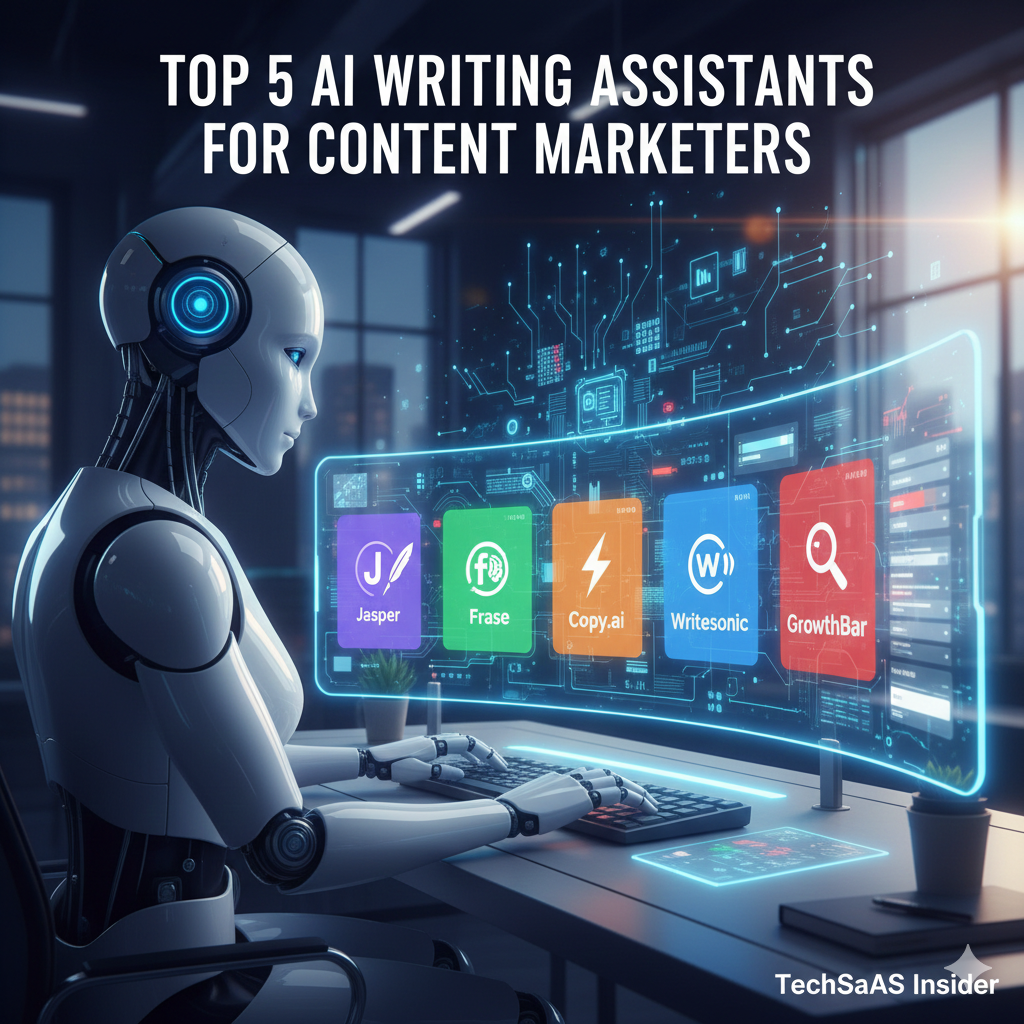
This comprehensive guide analyzes the top 5 AI writing assistants that have stood the test of time and innovation. We evaluate them on output quality, SEO integration, ease of use, and their ability to sound human.
1. Jasper (The Enterprise Powerhouse)
Jasper (formerly Jarvis) is widely considered the gold standard for professional content marketers and large teams. It was one of the first to market and has maintained its lead by focusing on business needs rather than just casual users.
The Core Value: “Brand Voice”
Most AI tools sound like… AI. They use words like “unleash” and “transform” too often. Jasper’s killer feature is its Brand Voice engine. You can upload your company’s style guide, past blog posts, and CEO’s bio. Jasper analyzes your tone, sentence structure, and vocabulary choices to ensure every piece of content it generates sounds like you, not a robot.
Key Features
- Jasper Art: An integrated AI image generator, allowing you to create unique thumbnails for your blog posts without leaving the interface.
- Boss Mode: A document editor that allows you to give open-ended commands (e.g., “Write a paragraph about the benefits of coffee, but make it sound like a pirate”). This flexibility is unmatched for long-form content.
- Team Collaboration: Robust folder organization and permission settings make it ideal for agencies managing multiple clients.
The Verdict
- Pros: Best-in-class output quality, deep training on marketing frameworks (AIDA, PAS), and excellent brand voice customization.
- Cons: It is the most expensive option on this list. The learning curve for “Boss Mode” commands can be steep.
- Best For: Agencies and mid-to-large marketing teams who need to protect brand integrity at scale.
2. Copy.ai (The Workflow Automation King)
If Jasper is for long-form writers, Copy.ai is for growth hackers and social media managers who need speed.
The Core Value: “Workflows”
In 2025, Copy.ai pivoted from just writing text to automating entire marketing tasks. Their Workflows feature allows you to chain prompts together.
- Example Workflow: You feed it a URL of a webinar. The workflow automatically: 1) Summarizes the webinar, 2) Writes a blog post based on the summary, 3) Generates 5 Tweets, and 4) Writes a LinkedIn carousel. All in one click.
Key Features
- Zero Retention Policy: For enterprise clients, Copy.ai ensures that your data is not used to train their models, a huge plus for security-conscious firms.
- Chat by Copy.ai: An interactive chat interface similar to ChatGPT but with access to real-time web data, allowing you to research competitors and write about current events accurately.
- Templates: Over 90+ templates for very specific use cases (e.g., “Rejection Email,” “Instagram Caption,” “Product Description”).
The Verdict
- Pros: Incredible for high-volume, short-form content. The Workflows feature is a massive time-saver for repurposing content.
- Cons: Struggles slightly with very long, nuanced articles compared to Jasper.
- Best For: Social media managers and email marketers who need to generate hundreds of variations quickly.
3. Writesonic (The SEO & Accuracy Specialist)
Writesonic differentiates itself by addressing the two biggest complaints about AI: “It makes things up” (hallucinations) and “It doesn’t know what happened yesterday.”
The Core Value: “Chatsonic” & GPT-4
Writesonic includes Chatsonic, a tool often described as “ChatGPT with superpowers.” It is connected to Google Search in real-time. If you ask it to write an article about an event that happened this morning, it can do it accurately. Most other models are cut off at a specific date in the past.
Key Features
- SEO-Optimized Article Writer 5.0: This specific tool asks you for your target keyword and top competitors. It analyzes the top-ranking results on Google and generates an article structure designed specifically to outrank them.
- Photosonic: Built-in AI image generation.
- Landing Page Generator: It can generate code and copy for a full landing page, which is unique among writing tools.
The Verdict
- Pros: Real-time factual accuracy is a game-changer for news-based content. The interface is clean and affordable.
- Cons: The credit system can be confusing (different quality levels cost different amounts of credits).
- Best For: Bloggers and affiliate marketers who need SEO-ready content based on current trends.
4. Frase (The Content Strategist)
Frase is not just a writer; it is a researcher. It is designed for the “Research -> Write -> Optimize” workflow that SEO professionals live by.
The Core Value: “SERP Analysis”
Before writing a single word, Frase analyzes the top 20 results on Google for your target keyword. It extracts the headings, questions people ask, and key statistics used by your competitors. It then builds a “Content Brief” that guarantees your article covers the topic more comprehensively than the competition.
Key Features
- Content Scoring: As you write (or as the AI writes), Frase gives you a score (0-100) based on how well you have covered the topic compared to competitors. It suggests semantic keywords you are missing.
- Answer Engine: It identifies questions from “People Also Ask” and Quora, helping you structure your FAQ sections to win Google Snippets.
- Google Search Console Integration: It connects to your own data to show you which of your existing articles are decaying and need an AI refresh.
The Verdict
- Pros: Unbeatable for SEO research and content structuring. It ensures your content satisfies User Intent.
- Cons: The AI writing capabilities are good, but slightly less creative/fluid than Jasper.
- Best For: SEO specialists, content strategists, and agencies focused on organic traffic growth.
5. GrowthBar (The Blogger’s Best Friend)
GrowthBar started as an SEO Chrome extension and evolved into a full AI writing suite. It is designed for simplicity and speed.
The Core Value: “2-Click Blog Posts”
GrowthBar claims to help you write blog posts 10x faster. Its interface is stripped down to the essentials. You enter a keyword, it suggests a title and an outline (based on SEO data), and then writes the full post paragraph by paragraph.
Key Features
- Chrome Extension: You can use GrowthBar’s AI directly inside WordPress, Google Docs, or even while browsing the web to get keyword metrics.
- Internal Linking: A smart feature that suggests internal links to your other blog posts while you write, which is a tedious SEO task to do manually.
- Keyword Research: It includes a built-in keyword research tool (difficulty scores, search volume), saving you from paying for a separate tool like Ahrefs or SEMrush.
The Verdict
- Pros: Extremely easy to use. The integration of keyword data directly into the writing interface is brilliant.
- Cons: Less granular control over tone and style than the enterprise tools.
- Best For: Solo bloggers and content site owners who want an all-in-one SEO and writing tool.
6. The “Human Touch” Factor: Passing the AI Detection Test
In 2025, using these tools comes with a warning: Google prefers helpful, human-first content.
While these tools are powerful, “Set it and forget it” is a failed strategy. AI content often suffers from:
- Repetition: Repeating the same point three times in different ways.
- Lack of Anecdote: AI cannot tell a personal story about your experience.
- Hallucinations: Inventing facts or statistics.
The Hybrid Workflow: The most successful marketers use AI to generate the structure (30% of the work) and the first draft (50% of the work), but spend the remaining 20% on human editing. Adding personal insights, verifying data, and breaking up robotic sentence structures is essential to bypass “AI fatigue” among readers.
Conclusion: Which Tool Should You Buy?
- Go with Jasper if you are a business with a budget that needs to maintain a strict brand voice across multiple departments.
- Go with Copy.ai if you are a social media marketer needing to repurpose one piece of content into ten formats instantly.
- Go with Frase if you are an SEO who cares more about ranking on page 1 than creative flair.
- Go with Writesonic if you need factual accuracy regarding recent news events.
The best AI tool is the one that fits seamlessly into your existing workflow, turning the friction of a blank page into the momentum of a published post.