The Future of Work: AI-Driven Decision Making—From Intuition to Augmented Intelligence (2025 Guide)
For centuries, leadership has been defined by human experience, intuition, and the ability to synthesize complex information under pressure. Yet, in the modern economy, data volume doubles every two years. The sheer torrent of information—from market trends and competitor moves to internal efficiency metrics—has surpassed the cognitive capacity of even the most brilliant human leaders.
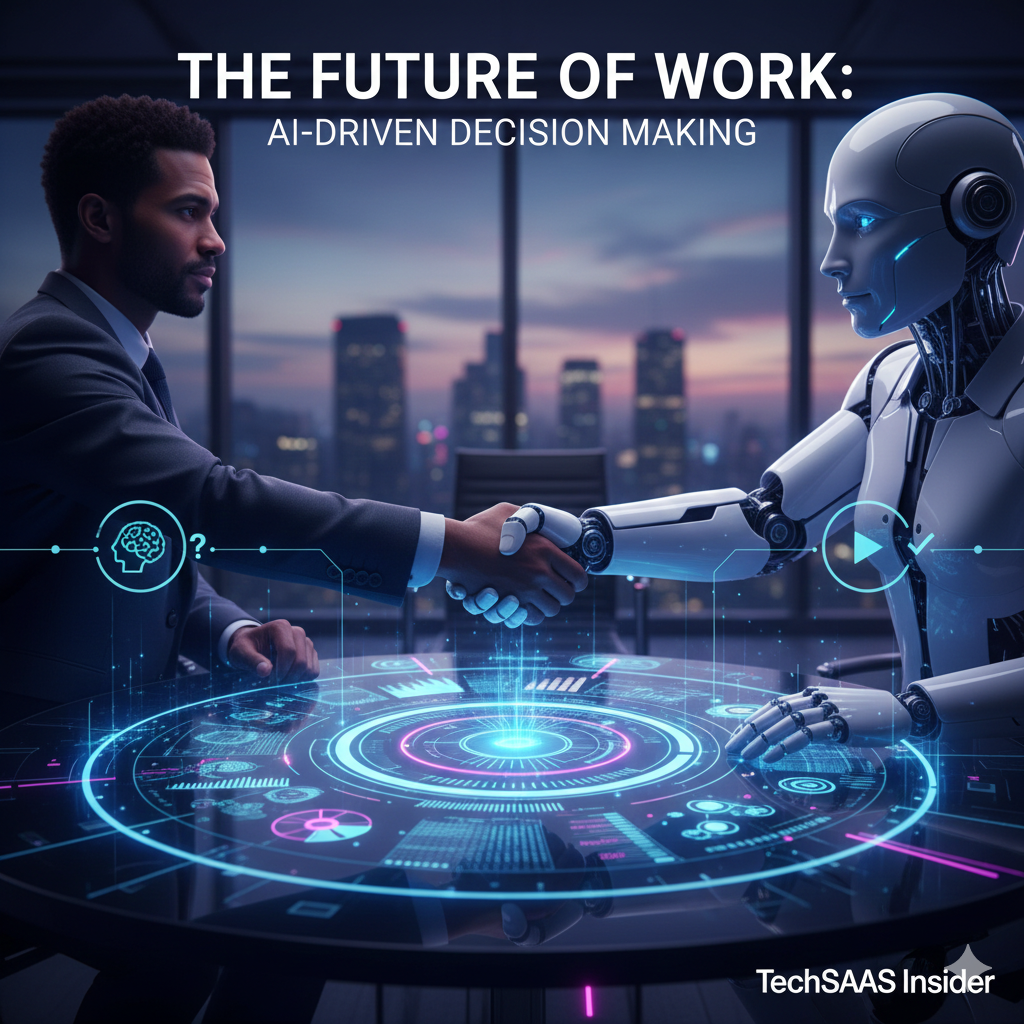
The future of work is not about replacing human decision-makers, but augmenting them with Artificial Intelligence.
AI-driven decision-making is the next revolution in corporate strategy. It moves organizations from relying on slow, historical data analysis to acting on predictive insights delivered in real-time. This transition transforms leaders from data analysts into strategic reviewers—empowered to make faster, smarter, and less biased choices.
This comprehensive guide dissects the strategic and operational applications of AI in decision-making, explores the critical ethical challenges (such as bias and accountability), and outlines the essential roadmap for C-Suite executives looking to implement augmented intelligence in their organizations in 2025.
1. The AI Paradigm Shift: Augmentation, Not Automation
It is crucial to distinguish between simple automation (e.g., automatically sending an email) and complex decision augmentation.
Human vs. Machine Strengths
- Human Leaders Excel At: Judgment, empathy, defining ethical boundaries, navigating novel or unprecedented situations, and managing soft skills.
- AI Algorithms Excel At: Processing massive, multidimensional datasets, simulating thousands of future scenarios, identifying subtle correlations, and eliminating human cognitive biases.
The goal is to pair the machine’s calculating speed with the human’s ethical and emotional intelligence. The Augmented Leader is a supervisor of data, not a gatherer of facts.
The Cost of Delay
Waiting one day to adjust pricing models based on a competitor’s move can cost millions. Waiting one quarter to analyze a pivot point can lead to market obsolescence. AI provides the immediate, objective insight necessary to reduce the “latency” of corporate reaction time.
2. AI in Strategic Decision Making (The C-Suite Focus)
AI’s most profound impact is at the highest level of corporate planning, where stakes are highest and data is most complex.
Market Forecasting and Trend Prediction
Traditional forecasting relies on linear models based on past performance. AI uses deep learning to analyze unstructured, real-time data (social media sentiment, satellite imagery, geopolitical tension) to predict non-linear shifts in consumer demand and market volatility.
- Application: A fashion brand can use AI to predict the precise inventory needed for a specific style 12 months out, minimizing stock surplus or shortage.
Risk Assessment and Scenario Planning
Before launching a new product line or entering a foreign market, leaders face uncertainty. AI models can run Monte Carlo simulations (thousands of random scenarios) to calculate the probability of success or failure under specific conditions (e.g., trade war, supply chain collapse).
- Application: Determining the optimal insurance policy or hedging strategy based on the AI’s risk profile assessment.
Optimized Resource Allocation (FinOps)
Budgeting is often political and based on historical precedent (OpEx). AI can provide data-driven recommendations on capital expenditure (CapEx) based purely on the predicted ROI.
- Application: AI can determine if moving budget from legacy server maintenance to cloud-native development will yield higher long-term value, moving the decision from internal negotiation to objective metric analysis.
3. AI in Operational Decision Making (The Daily Impact)
At the functional level, AI is streamlining high-volume, high-frequency decisions.
Dynamic Pricing and Revenue Management
AI monitors real-time demand elasticity, competitor pricing, and inventory levels to adjust prices dynamically. This is common in airlines and e-commerce.
- Application: A hotel chain uses AI to raise or lower room rates every minute based on local events, weather, and competitor booking rates, maximizing revenue per available room (RevPAR).
Supply Chain and Logistics Optimization
AI provides predictive maintenance for machinery, forecasts warehouse demand, and dynamically reroutes shipping containers to avoid global chokepoints.
- Application: The system identifies that a machine part has an 80% chance of failing next month, automatically ordering the replacement and scheduling maintenance during off-peak hours, preventing costly downtime.
HR and Talent Acquisition
AI identifies skills gaps in the current workforce and recommends targeted training or hiring based on the company’s 3-year strategic goals. It can also analyze job descriptions for biased language to improve diversity in the application pool.
4. The Critical Challenge: Ethical AI Governance
The transition to AI-driven decisions is fraught with ethical peril that must be managed by human leadership.
The Problem of Data Bias
AI models are trained on historical data, which reflects historical human biases (racial, gender, economic). If the training data is biased, the AI’s decisions—in loan approvals, hiring, or criminal justice—will perpetuate and amplify those biases.
- Mitigation: Rigorous auditing of input data sets and active intervention by humans to remove sensitive demographic features during training.
The “Black Box” Problem (Explainable AI – XAI)
Some complex deep learning models cannot fully articulate why they reached a conclusion. If an AI denies a customer a loan, regulators or internal compliance teams need to know the rationale.
- Mitigation: Companies must prioritize Explainable AI (XAI) systems that provide human-readable justifications (e.g., “The model rejected the loan because the debt-to-income ratio exceeds 40%, not because of the applicant’s location”).
Accountability and the “Human in the Loop”
Who is responsible when an AI makes a catastrophic error (e.g., a fatal autonomous driving crash or a flawed investment)?
- Policy: The legal and ethical consensus is clear: The human leader who approves the decision remains accountable. Organizations must implement “Human-in-the-Loop” protocols where AI provides the recommendation, but a qualified human provides the final review and sign-off.
5. Implementation Roadmap for Augmented Intelligence
- Start Small, High Volume: Begin by automating high-volume, low-risk decisions (e.g., customer service routing, inventory reordering). This builds organizational trust and data cleanliness.
- Define Governance: Establish an internal AI Ethics Board comprising legal, security, and diversity leaders to oversee data quality and decision fairness.
- Invest in Data Culture: AI is useless without clean, unified data. Break down data silos and invest in data science literacy across management.
- Prioritize XAI: For critical systems (HR, Finance), insist on platforms that provide transparent decision rationales.
Conclusion: The New Definition of Leadership
AI-driven decision-making is the ultimate force multiplier for the modern executive. It frees the human brain from the tedious work of calculation, allowing leaders to focus on the truly strategic, ethical, and empathetic aspects of their roles. The future leader will not be the one with the best gut feeling, but the one who best governs the machine that sees what no human can.