
The Complete Guide to Prompt Engineering for Content Creators: Mastering the AI Interface in 2025
The generative AI revolution has redefined the content industry. In 2025, the most valuable skill for a content creator is no longer just writing; it’s Prompt Engineering—the art and science of communicating effectively with a Large Language Model (LLM) to generate a desired, high-quality outcome.
Many users fail because they treat AI like a search engine (e.g., “Write about CRM”). The resulting output is generic, repetitive, and fails the critical quality standard set by Google (E-E-A-T). The power of AI is directly proportional to the quality of the prompt. Garbage In, Garbage Out.
Prompt Engineering transforms the creator from a keyboard operator into an architect of ideas. This definitive guide breaks down the core principles, advanced chaining techniques, and specific strategies content marketers must employ to consistently generate authoritative, unique, and ready-to-publish content that ranks and converts.
1. Defining Prompt Engineering: The New Language of Creation
Prompt Engineering is the discipline of structuring text input to elicit a specific, high-fidelity response from an LLM (like Gemini, Claude, or ChatGPT). It is the bridge between human intent and machine execution.
The Problem of “Generic Output”
LLMs are predictive machines. They calculate the most probable next word based on their training data. If you provide a general prompt, the AI will provide a general, average answer—the most probable response. To get an exceptional answer, you must provide exceptional constraints that push the model beyond its generic averages.
The Goal: Minimizing Iteration
A poorly crafted prompt requires 10 rounds of refinement (“Make it shorter,” “Now make it funnier,” “Now add a table”). A master prompt gets the output 90% right on the first try, saving massive amounts of editing time.
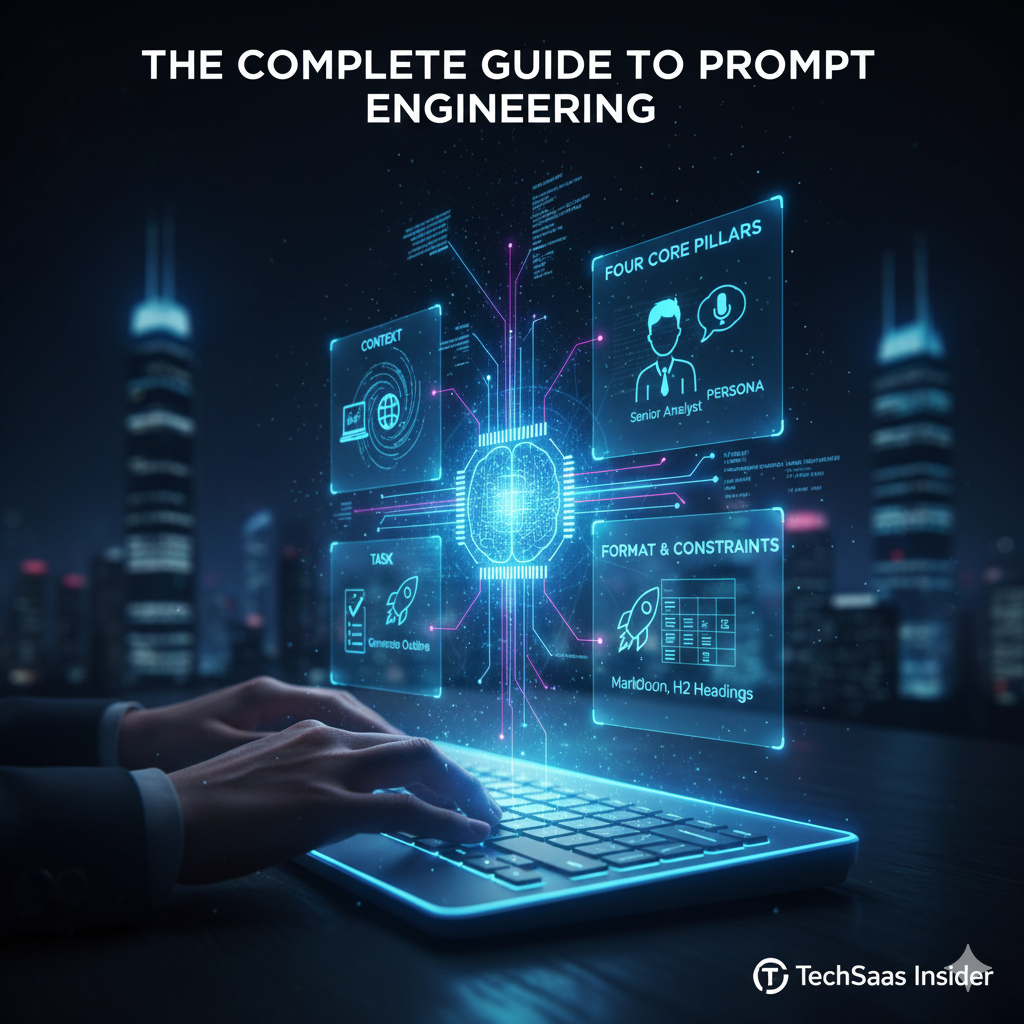
2. The Four Pillars of a Master Prompt (The Blueprint)
Every effective prompt, regardless of the output medium, must contain these four non-negotiable elements.
Pillar 1: Persona (The Authority)
You must give the AI a role to play. This immediately elevates the tone, vocabulary, and expertise level.
- Bad: “Write about cybersecurity.”
- Good: “Act as a CTO of a Fortune 500 company writing an internal memo to the security team.”
- Better: “Act as a leading SaaS product reviewer for a B2B tech publication, using a critical and authoritative tone.”
Pillar 2: Context (The Angle)
The AI needs to understand the scenario, the audience, and the purpose of the content.
- Bad: “Compare Slack and Teams.”
- Good: “Compare Slack and Teams for a target audience of non-technical HR managers who manage hybrid teams and need to decide which tool promotes asynchronous communication better.”
Pillar 3: Format & Constraints (The Structure)
This defines the physical output. This is essential for SEO and readability.
- Mandatory Constraints: “Write a minimum of 1,800 words.” “Use a reading level suitable for a 10th grader.” “Ensure the article is structured using Markdown H2 and H3 headings.”
- Specific Formatting: “Include a comparison table with 5 rows and 4 columns.” “Start with a 200-word executive summary.”
Pillar 4: Goal & Negative Constraints (The Red Lines)
You must define success and tell the AI what to avoid.
- Goal: “The primary goal is to convince the reader to book a demo of the tool, not just read about it.”
- Negative Constraints: “Do not use the word ‘synergy,’ ‘unleash,’ or ‘game-changer.'” “Do not use clichés or passive voice.”
3. Advanced Techniques for High-Fidelity Content
Master prompters use strategies that turn the AI into a powerful research and execution partner.
Technique 1: Chain Prompting (Divide and Conquer)
Never ask the AI to write a 2,000-word article in one go. The model will lose focus and detail by Section 3. Break the task down:
- Phase A (Research): “Analyze the top 10 search results for [Keyword]. Identify the 5 most critical sub-headings that must be covered.”
- Phase B (Outline): “Using the sub-headings from Phase A, create a detailed, 8-section outline. Add 3 bullet points of necessary content under each H2.”
- Phase C (Drafting): “Now, write ONLY Section 3 (H2) based on the outline from Phase B. The content must be detailed and have a minimum of 350 words.”
- Phase D (Editing): “Review the draft from Phase C. Improve the call-to-action and simplify the technical jargon.”
Technique 2: Few-Shot Learning (Training the AI)
This technique involves providing the AI with examples of what a “good” answer looks like before asking it to perform the task.
- Method: “Here is an example of a successful 5-star product review we published last year [paste example text]. Adopt this exact tone, structure, and critical analysis style to write a new review for Product X.”
- Benefit: It instantly bypasses the AI’s generic template and ensures brand alignment.
Technique 3: SEO Integration (Semantic Depth)
Google’s ranking algorithms look for topical authority (covering a topic comprehensively).
- The Strategy: Instruct the AI to incorporate LSI (Latent Semantic Indexing) keywords.
- Prompt Example: “Before writing, list 15 semantically related keywords (LSI keywords) that should appear naturally in the article, such as ‘API’, ‘MFA’, ‘single sign-on’, and ‘auditing’. Do not use these words, use the ideas behind them.”
4. Prompting for Different Media: Adapt Your Output
The prompt changes depending on the final destination.
| Output Medium | Primary Constraint | Focus |
| Blog Post (Pillar) | Word Count, SEO H2/H3 Structure | Expertise, Authority, Supporting data. |
| Ad Copy (Facebook) | Character/Word Count, Emotional Hook | Pain-Agitate-Solution (PAS), urgency, clear CTA. |
| Video Script (YouTube) | Pacing, Tone (Casual), Visual Cues | Short sentences, placeholders for B-roll footage. |
| Email Sequence | Subject Line Effectiveness, A/B Testing | Clear segmentation reference, low friction action. |
5. Common Pitfalls and Troubleshooting
Pitfall 1: Hallucinations
The AI invents facts or statistics.
- Solution: Use Verification Prompts. “For every statistic you include, append a verifiable source or state clearly that the statistic is a model estimate, not a real number.”
Pitfall 2: The Repetitive Tone
The AI uses the same vocabulary and cadence throughout the article.
- Solution: Add Style Prompts. “Vary your sentence structure. Use both short, punchy sentences and longer, analytical ones.”
Pitfall 3: Being Too Polite
The AI sometimes apologizes or uses excessive filler language.
- Solution: Use Negative Constraints. “Remove all instances of unnecessary transition phrases like ‘Furthermore,’ or ‘In conclusion, it is clear that…'”
Conclusion: The Ultimate Content Advantage
Prompt Engineering is the high-leverage activity of the modern content creator. By mastering the Four Pillars—Persona, Context, Format, and Goal—you shift the work from tedious drafting to strategic architecture.
In 2025, the best writers aren’t those who can type the fastest; they are the ones who can command the machine most effectively. The discipline of prompt engineering is what grants you the competitive advantage: the ability to execute complex content strategies at scale, consistency, and unparalleled speed.