How AI is Revolutionizing Customer Service Automation: From Cost Center to Revenue Engine (2025 Guide)
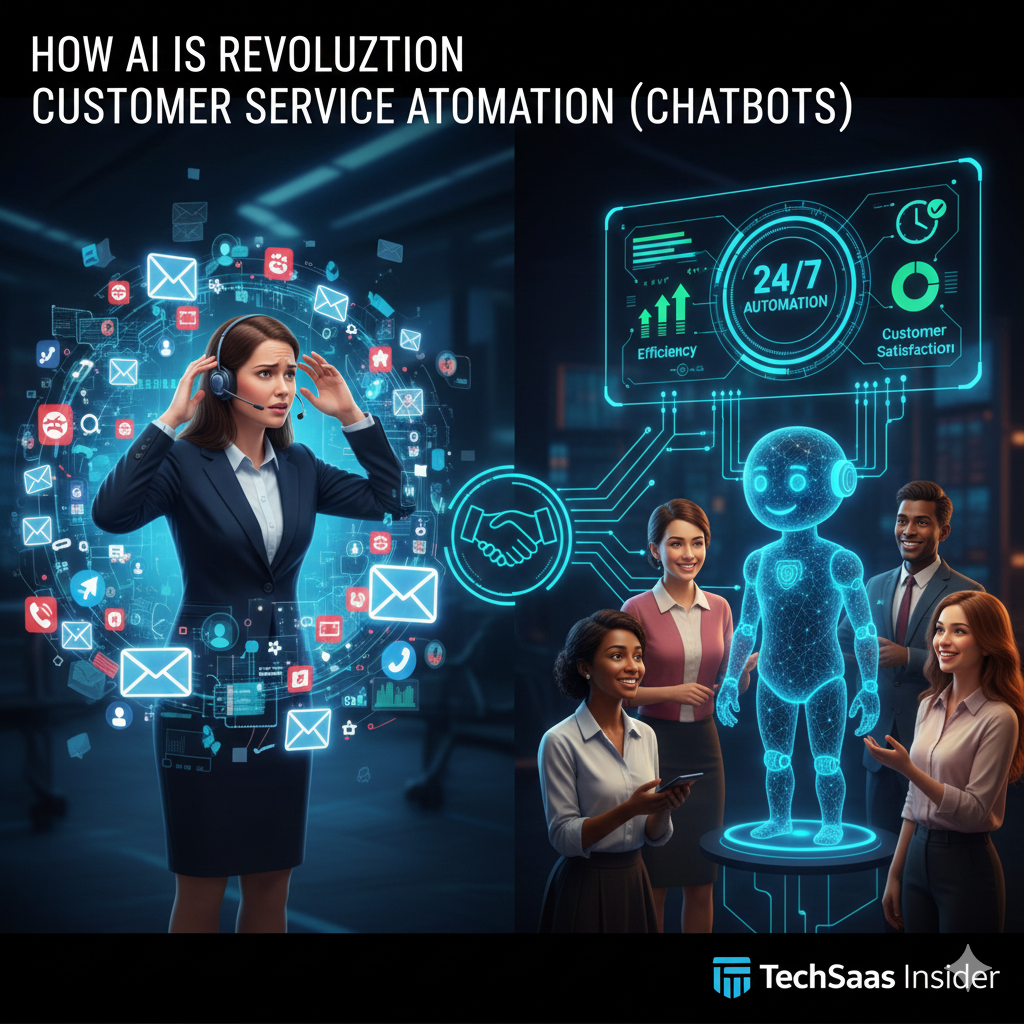
For decades, customer service has been viewed as a necessary evil—a cost center required to manage complaints and retain customers. Yet, in 2025, customer expectations have rendered traditional service models obsolete. Customers demand instant, 24/7 support across every channel (web chat, WhatsApp, SMS, email). Scaling human teams to meet this demand is financially unviable and leads to agent burnout.
The only scalable solution is the integration of Artificial Intelligence (AI).
AI has evolved far beyond the clumsy, rules-based chatbots of the past that could only answer simple “Yes/No” questions. Modern Conversational AI, powered by Large Language Models (LLMs), can understand complex intent, recognize emotional sentiment, and personalize responses, transforming customer service from a reactive cost center into a proactive revenue engine.
This comprehensive guide details the three pillars of AI customer service revolution: intelligent automation, agent augmentation, and predictive engagement. We explore how businesses can leverage tools like Zendesk, Intercom, and HubSpot to meet global demand while improving efficiency.
1. The Business Imperative: The Case for AI Adoption
Why are businesses rushing to implement AI in their service departments? The ROI is immediate and measurable.
24/7 Global Availability
A human team cannot staff every time zone without massive expense. AI works tirelessly, ensuring that a customer in Tokyo or London receives the same instant response as a customer in New York, regardless of the time of day. This drives higher satisfaction and reduces cart abandonment.
Call and Contact Deflection
The goal of AI is to solve common, repetitive questions instantly. Up to 80% of support tickets are for the same issues (e.g., “Where is my order?” or “How do I reset my password?”). By deflecting these contacts away from the human queue, AI frees up human agents to focus exclusively on complex, high-value, or emotional issues.
Scaling Without Hiring
AI allows a company to grow its customer base by 200% without doubling its support headcount. This direct reduction in operational expenditure (OpEx) makes AI one of the fastest ROI investments in the modern tech stack.
2. Pillar 1: Conversational AI Automation (The Front Line)
This is the most visible form of AI in service: the sophisticated chatbot.
Natural Language Processing (NLP) and Intent Recognition
The old chatbots relied on keywords (“If user types ‘price’, answer with pricing page link”). Modern AI uses NLP to understand the intent behind the messy human sentence.
- Example: A user types, “My widget is broken and I’m very angry, I want a refund now.” The AI recognizes the Intent (Refund) and the Sentiment (Angry), and prioritizes the request correctly, often before routing to a human.
RAG Architecture and Factual Accuracy
General LLMs (like standard ChatGPT) hallucinate facts. Businesses cannot tolerate this. The solution is Retrieval-Augmented Generation (RAG).
- How it Works: The AI is connected to a company’s secure, internal knowledge base (e.g., your private database of product manuals and internal policy documents). When a customer asks a question, the AI first retrieves the answer from the trusted source, and then generates the human-like response. This ensures factual accuracy and compliance.
Omnichannel Deployment
AI is no longer restricted to a web popup. Top platforms allow you to deploy the same AI brain across:
- WhatsApp and SMS: Handling quick customer queries via text.
- In-App Chat: Guiding users through complex setup processes inside the software.
- Email: Automatically summarizing long email chains and suggesting categorization tags.
3. Pillar 2: Agent Augmentation (The Human Helper)
AI doesn’t just replace agents; it transforms the human role into that of a highly efficient supervisor.
Real-Time Scripting and Knowledge Base Suggestion
While a human agent is typing a response, the AI monitors the conversation in real-time. It suggests the most relevant internal policy articles, pre-written answers, or technical troubleshooting steps directly into the agent’s chat window. This dramatically reduces the time needed to search for information and ensures consistent, accurate responses.
Post-Call/Chat Summaries
After a complex phone call or chat session, human agents spend valuable time writing a summary of the interaction for the CRM. AI automatically generates a concise summary, listing the problem, the solution, and the next step, freeing the agent to immediately take the next call.
Sentiment-Based Prioritization
If the AI detects that a customer’s sentiment score has dropped below a critical threshold (e.g., they used harsh language or capital letters), the system instantly flags the ticket, ensuring a supervisor can intervene before the customer posts a complaint on social media.
4. Pillar 3: Predictive and Proactive Service
The ultimate goal of AI is to stop problems before they happen.
Churn Prediction
AI models analyze user behavior: have they logged in less frequently? Have they viewed the “Cancellation” page? Have they filed multiple technical support tickets in a short period? AI identifies customers with a high probability of churning (leaving) and alerts the Customer Success team for a proactive intervention.
Proactive Outreach and Guiding
AI can monitor product usage. If a user gets stuck on a complex setup page for 10 minutes, the AI can automatically trigger a contextual chat message offering the exact tutorial needed, or schedule a call with a human expert—preventing the user from abandoning the product in frustration.
Service Hub Integration (Sales & Marketing)
By categorizing service issues, AI identifies weak spots in your product or marketing message. If 80% of calls are about one missing feature, the AI reports this to the Product team. If calls are frequent because of misleading ad copy, the AI flags the Marketing team. Customer service becomes a source of product intelligence.
5. Implementation Strategy: Making the AI Transition Work
1. Define the Handover Protocol (The “Escalation Policy”)
The most frustrating experience is getting stuck in an AI loop. Clearly define the triggers for a seamless handover to a human:
- Complexity: If the query requires access to sensitive account information or involves more than two steps of troubleshooting.
- Keywords: If the user types “Speak to a Manager,” “Cancel,” or “Legal.”
- Sentiment: If the user’s frustration level is too high.
2. Start with Low-Risk Tasks
Do not deploy AI to handle sensitive financial issues on day one. Start with:
- Tier 1: FAQs, store hours, refund policies, login links.
- Tier 2: Order status tracking, basic troubleshooting.
- Leave Tier 3 (custom solutions, technical debugging) for humans.
3. Continuous Training
AI is not static. Human agents must spend time “correcting” the AI’s failed attempts. The more feedback the AI receives on its mistakes, the smarter and more accurate it becomes over time. This continuous feedback loop is the true secret to AI service success.
Conclusion: The New Service Standard
The customer service landscape in 2025 is defined by AI. It offers the speed, scalability, and 24/7 availability that human teams simply cannot match alone. By strategically deploying AI for deflection and augmentation, businesses transform their service desk from a necessary expenditure into a powerful tool for customer retention and deep operational intelligence. Those who resist this AI shift will be left fighting expensive, losing battles against customer dissatisfaction.