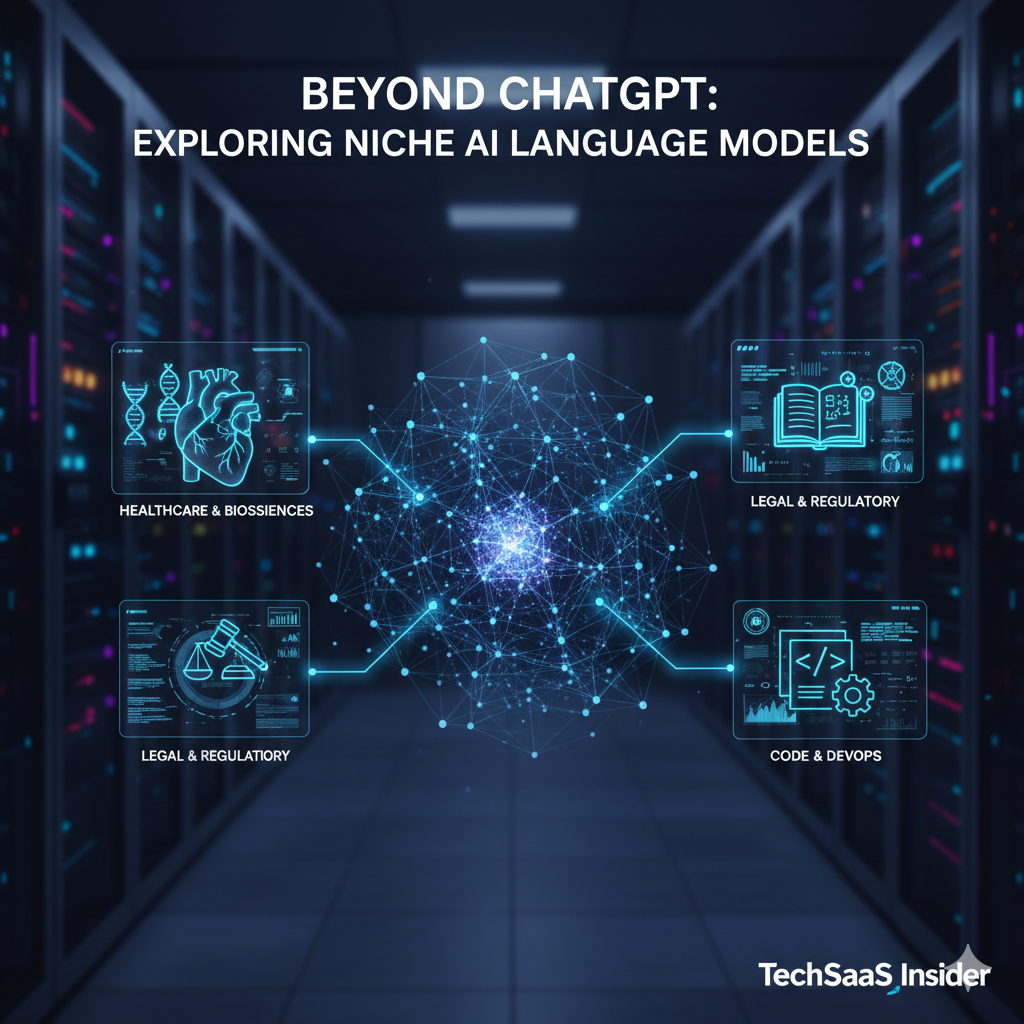
The introduction of Large Language Models (LLMs) like ChatGPT, Gemini, and Claude has catalyzed a revolution in productivity, demonstrating the profound capabilities of general-purpose AI. However, for organizations operating in highly regulated, specialized, or complex domains—such as legal compliance, healthcare research, or advanced coding—general LLMs often hit a wall. They lack the necessary domain-specific knowledge, data privacy controls, and fine-grained accuracy required for mission-critical tasks. The next wave of innovation is found in Niche AI Language Models: specialized LLMs designed, trained, and optimized for highly specific industry applications. This guide explores the critical move beyond general-purpose tools, detailing where niche LLMs offer superior performance, security, and precision in 2025.
1. The Limitation of General-Purpose LLMs in Enterprise
General LLMs are trained on the vast expanse of the public internet. While this gives them impressive conversational fluency, it creates two critical weaknesses in a professional context:
- Lack of Domain Depth: They struggle with highly technical, proprietary, or specific industry jargon (e.g., obscure legal statutes, complex genomic data). Their answers can be accurate 80% of the time, but the 20% inaccuracy is unacceptable in fields where errors carry high liability.
- Data Security and Privacy: General LLMs often operate in a shared, public cloud environment. Enterprises handling sensitive client data, trade secrets, or patient records cannot risk exposing this information to external AI models.
2. Niche Model Category 1: Healthcare and Life Sciences
In the medical field, accuracy is everything, making niche LLMs essential for diagnostic support, research, and documentation.
Specialized Models for Medical Data (Example: BioGPT)
Models trained exclusively on massive datasets of biomedical literature, clinical trial results, and genomic sequences provide expertise unmatched by general LLMs.
- Use Case: Automatically summarizing complex patient histories, identifying potential drug interactions from disparate studies, or rapidly categorizing thousands of medical research papers for a literature review.
- Advantage: These models reduce the risk of clinical “hallucinations” (inaccurate AI output) because their knowledge base is strictly limited to verifiable scientific facts.
Secure, Private Deployments
Many hospitals and pharmaceutical companies now deploy custom LLMs on-premise or within their own private cloud environments. This ensures that confidential patient data (PHI) or proprietary drug research never leaves the company’s secure infrastructure, satisfying crucial HIPAA compliance requirements.
3. Niche Model Category 2: Legal and Financial Compliance
The legal and financial sectors rely on interpreting vast, evolving volumes of regulatory text, making them ideal targets for specialized AI.
Regulatory Analysis and Risk Scoring
Niche models trained on international law codes, financial filings, and compliance documents (e.g., Dodd-Frank, GDPR, Basel III) can rapidly assess the risk of a contract or transaction.
- Use Case: Automating the identification of potential liabilities in new contracts, checking loan applications against complex regulatory requirements, or instantly comparing a company’s internal policy to a new governmental statute.
- Advantage: Speed and precision. What takes a team of paralegals weeks to analyze, a specialized LLM can review in minutes, dramatically accelerating due diligence and reducing human error.
Document Search and E-Discovery
In legal processes, finding specific clauses across millions of documents is common. Niche LLMs are optimized for semantic search, understanding the meaning and intent of a request rather than just matching keywords. This makes e-discovery (finding relevant evidence) far faster and more accurate.
4. Niche Model Category 3: Advanced Code Generation and DevOps
While general LLMs (like GitHub Copilot) are excellent coding assistants, niche models push the boundaries of software development further.
Language-Specific Optimization
Some LLMs are fine-tuned exclusively on codebases of niche or legacy programming languages (e.g., COBOL, Scala, or proprietary internal frameworks).
- Use Case: Translating old codebases into modern languages, debugging complex legacy systems, or generating highly optimized, performance-critical code in specific languages (e.g., Rust or C++).
- Advantage: They reduce technical debt and allow companies to modernize core systems faster by utilizing the specialized knowledge the model gained from those specific code repositories.
Internal Knowledge Base Integration (RAG)
Many organizations use the Retrieval-Augmented Generation (RAG) architecture, where a general LLM (like Gemini) is connected to a company’s internal, proprietary documentation. This allows the AI to answer questions using only internal data (e.g., specific company policies, internal APIs, or security protocols), providing niche expertise without sharing proprietary data externally.
5. Conclusion: The Future is Specialized
The era where one LLM solves all problems is ending. The future of AI in the enterprise is defined by specialization and security. While general LLMs will continue to power consumer tools, niche AI models—whether privately hosted or fine-tuned on specialized domain knowledge—will be the key drivers of innovation, compliance, and competitive advantage across high-stakes industries. Leaders must now shift their focus from asking, “Which general AI should we use?” to “Which specialized dataset should we train our niche AI on?”