Buying a Ferrari doesn’t make you a race car driver. In the same way, purchasing a subscription to a project management tool like Jira, Monday.com, or Asana doesn’t magically turn a team into a high-performance organization. Software alone cannot fix poor planning, broken communication, or unclear goals. The real engine of productivity is not the tool itself, but the methodology behind how work is organized, executed, and reviewed. In 2025, with teams working remotely, deadlines accelerating, and competition intensifying, choosing the right project management framework can mean the difference between shipping consistently and constantly struggling to catch up.
Yet project management has become a jungle of buzzwords. Agile, Scrum, Kanban, Waterfall… these terms are thrown around in meetings, job interviews, and marketing materials as if they were interchangeable. They are not. Each methodology has a distinct philosophy, workflow, and ideal use case. Understanding how they work is the only way to choose wisely. This guide breaks down the most important project management methodologies used in 2025 and explains them clearly, without jargon, so you can decide what truly fits your team.
The Traditional Model: Waterfall
Before Agile became the industry standard for software and digital products, Waterfall ruled project management. It is the classical, structured approach that many businesses still recognize today. Waterfall operates in a linear sequence where each stage must be fully completed before the next one begins. Requirements come first, followed by design, development, testing, and finally maintenance or delivery. The entire project is planned upfront, usually with detailed documentation describing everything that will be built.
The appeal of Waterfall lies in its predictability. Decision-makers know from the beginning what they are paying for, when delivery is planned, and what outcomes they should expect. For industries like construction or manufacturing, where changes mid-process are extremely expensive or even impossible, this structure provides stability and safety. You cannot build the second floor of a building before laying the foundation. In those environments, Waterfall makes sense.
However, the rigidity that makes Waterfall reliable is also what makes it dangerous for digital projects. In technology, learning happens during development. User needs evolve. Markets change. New constraints appear. When teams discover late in the project that an early assumption was wrong, the cost of correction can be brutal. Going back to the design phase after finishing implementation is like tearing down a nearly finished house to change the architecture. That is why Waterfall struggles in fast-moving digital environments — it assumes certainty where uncertainty dominates.
Agile: A Mindset, Not a Method
Agile is often treated as a methodology, but that is a misunderstanding. Agile is a philosophy. It is a way of thinking about work, risk, and change. It was formalized in 2001 by the Agile Manifesto, a group of developers who were frustrated by the inefficiency and rigidity of traditional project planning.
Agile rejects the idea that everything can be planned in advance. Instead, it accepts uncertainty as a fact of modern work. Rather than building one massive plan and hoping it survives reality, Agile encourages teams to build in small pieces, review continuously, and adapt constantly. It values collaboration over documentation, working software over long reports, and customer feedback over rigid contracts.
What makes Agile powerful is not its tools but its attitude. Agile teams expect change and design systems that respond to it. They release early versions, learn from users, and adjust course without fear. In a digital economy where customer behavior is unpredictable, Agile is no longer a trend — it is survival.
Scrum and Kanban do not replace Agile. They implement it. They are practical expressions of the philosophy, each offering a different structure for how Agile principles are applied in daily work.
Scrum: Discipline Through Structure
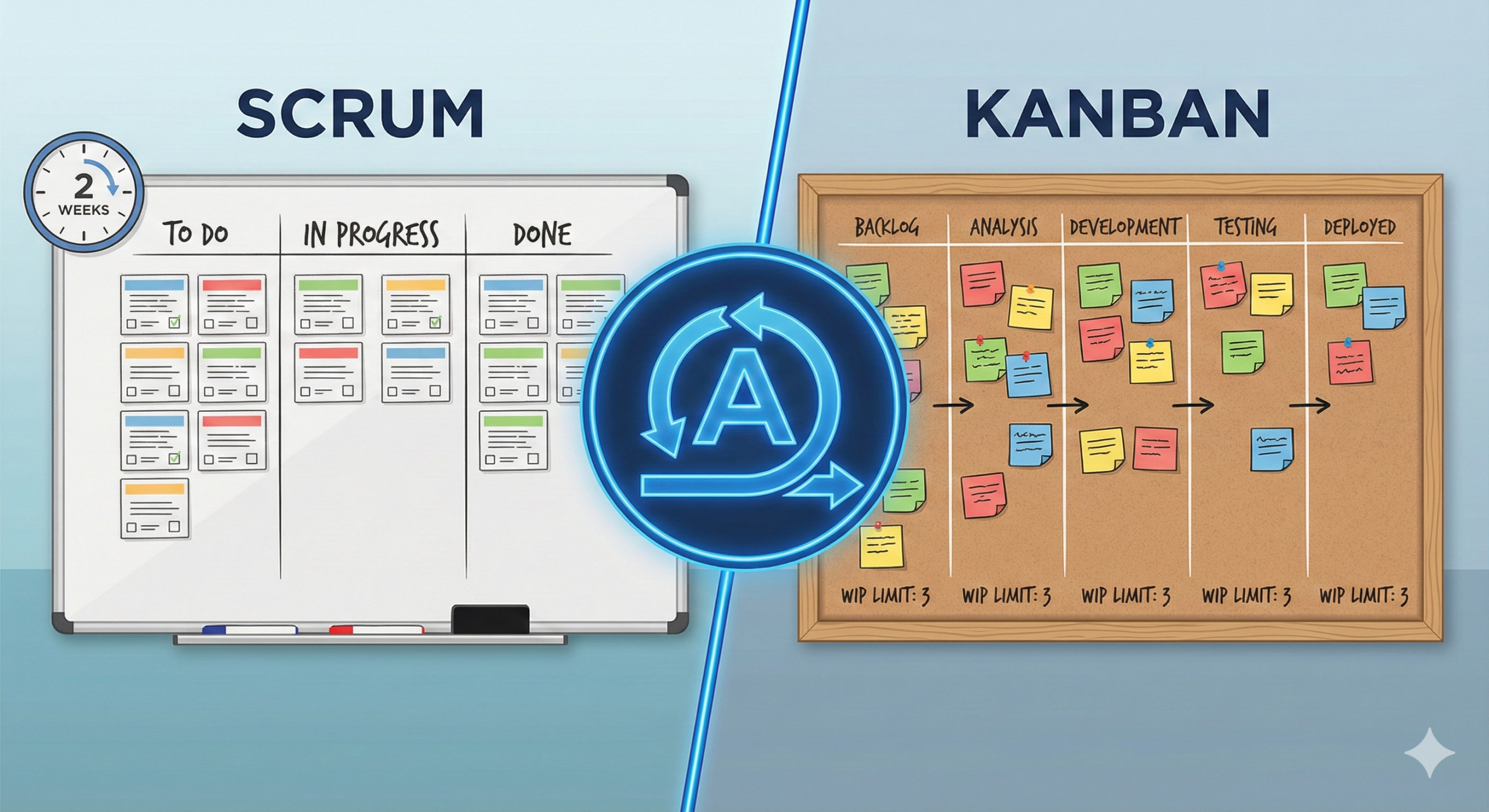
Scrum is the most popular framework used to implement Agile in structured teams, especially in software development. While Agile promotes flexibility, Scrum provides rules. It creates a rhythm of work by organizing tasks into short cycles called “Sprints,” which usually last two weeks. Instead of releasing a product after many months of development, Scrum teams aim to deliver something functional after every sprint.
This approach changes how planning works. Instead of predicting the future months in advance, Scrum teams plan only what they can reasonably achieve in the next sprint. At the beginning of each cycle, the team selects a group of tasks from a prioritized list called the backlog. At the end of the sprint, the team reviews what was completed, demonstrates the work, and reflects on how to improve next time.
Scrum defines clear roles that help teams operate smoothly. The Product Owner represents the customer and decides which features matter most. The Scrum Master protects the team from distractions and ensures the process runs correctly. The development team focuses purely on building. This separation of responsibilities reduces confusion and creates accountability.
Scrum works best when complexity is high and regular delivery matters. Teams that are building products, launching features, or working on evolving platforms benefit from its cadence. The sprint forces momentum. Deadlines become predictable. Progress becomes visible. But Scrum also requires discipline. Teams that resist meetings, ignore sprint boundaries, or fail to reflect quickly lose its benefits.
Kanban: Mastering Flow Over Deadlines
Kanban takes a completely different approach to project management. Instead of dividing work into time-based cycles, it organizes work by flow. The focus is not on sprints but on visualization. Every task appears on a board, moving through stages such as “to do,” “in progress,” and “done.” At a glance, everyone sees where work is stuck and where it moves smoothly.
The most powerful concept in Kanban is the limit on work in progress. Instead of starting everything at once, teams restrict how many tasks can be active at any moment. This forces completion before expansion. In practice, this means fewer half-finished projects, lower stress, and better output quality.
Kanban shines in unpredictable environments. Support teams, marketing teams, and maintenance crews deal with constant interruptions and priority shifts. Planning two weeks ahead is often unrealistic. Kanban allows work to enter the system continuously without disrupting the process.
Unlike Scrum, Kanban does not require formal roles or ceremonies. It naturally fits into existing teams with minimal friction. That makes it ideal for organizations that want improvement without organizational shock.
Scrum vs Kanban — Which Is Right for You?
Choosing between Scrum and Kanban comes down to the nature of your work, not ideology. Scrum exists to create focus and rhythm. Kanban exists to create efficiency and clarity. Scrum uses deadlines to drive urgency. Kanban uses limitation to drive completion.
If your team builds new features regularly and benefits from structured planning, Scrum will likely improve your performance. If your team handles unpredictable tasks or constant requests, Kanban will help you avoid overload and chaos. One is not superior to the other. They solve different problems.
The Rise of Scrumban: Flexibility with Discipline
In reality, most companies do not follow any framework perfectly. They adapt. The hybrid approach known as “Scrumban” combines Scrum’s planning structure with Kanban’s workflow optimization. Teams plan in sprints, but also limit work in progress. They use deadlines without becoming slaves to them. They use structure without sacrificing responsiveness.
In 2025, flexibility beats purity.
Frameworks should serve teams, not control them.
Final Thoughts
Project management is not about methodology worship. It is about delivering value. It is about alignment, clarity, and momentum. No framework fixes broken communication or weak leadership. But the right framework amplifies good teams and exposes bad habits quickly.
Start simple. Visualize your work. Improve flow. Introduce structure when chaos appears. Adapt constantly. There is no single correct methodology. There is only the one that allows your team to work clearly, consistently, and with confidence.
The tool will never replace discipline.
The methodology will never replace leadership.
But the right system will make everything easier.