AWS vs. Azure vs. GCP: The Ultimate Cloud Comparison for Enterprise Strategy (2025 Guide)
The shift to cloud computing is no longer an optional migration; it is the definitive foundation of modern business agility. However, the decision of which platform to use—Amazon Web Services (AWS), Microsoft Azure, or Google Cloud Platform (GCP)—is one of the most critical and complex strategic choices facing any CIO, CTO, or Head of Engineering in 2025.
Choosing a cloud provider is not just about pricing; it’s about architectural philosophy, service availability, talent availability, and long-term vendor lock-in risk. While all three providers offer the fundamental IaaS (Infrastructure as a Service) stack (compute, storage, networking), their focus areas, pricing models, and specialized AI/ML capabilities differ dramatically.
This comprehensive, objective guide dissects the strengths and weaknesses of the “Big Three” cloud providers. We analyze their position in the market, deep-dive into their specialized services (AI, Data, Serverless), and provide a strategic framework to help your organization select the right cloud partner for your unique technical and business requirements.
1. Market Overview: The Current Landscape (2025)
The cloud market is dominated by a clear leader, but the others specialize effectively.
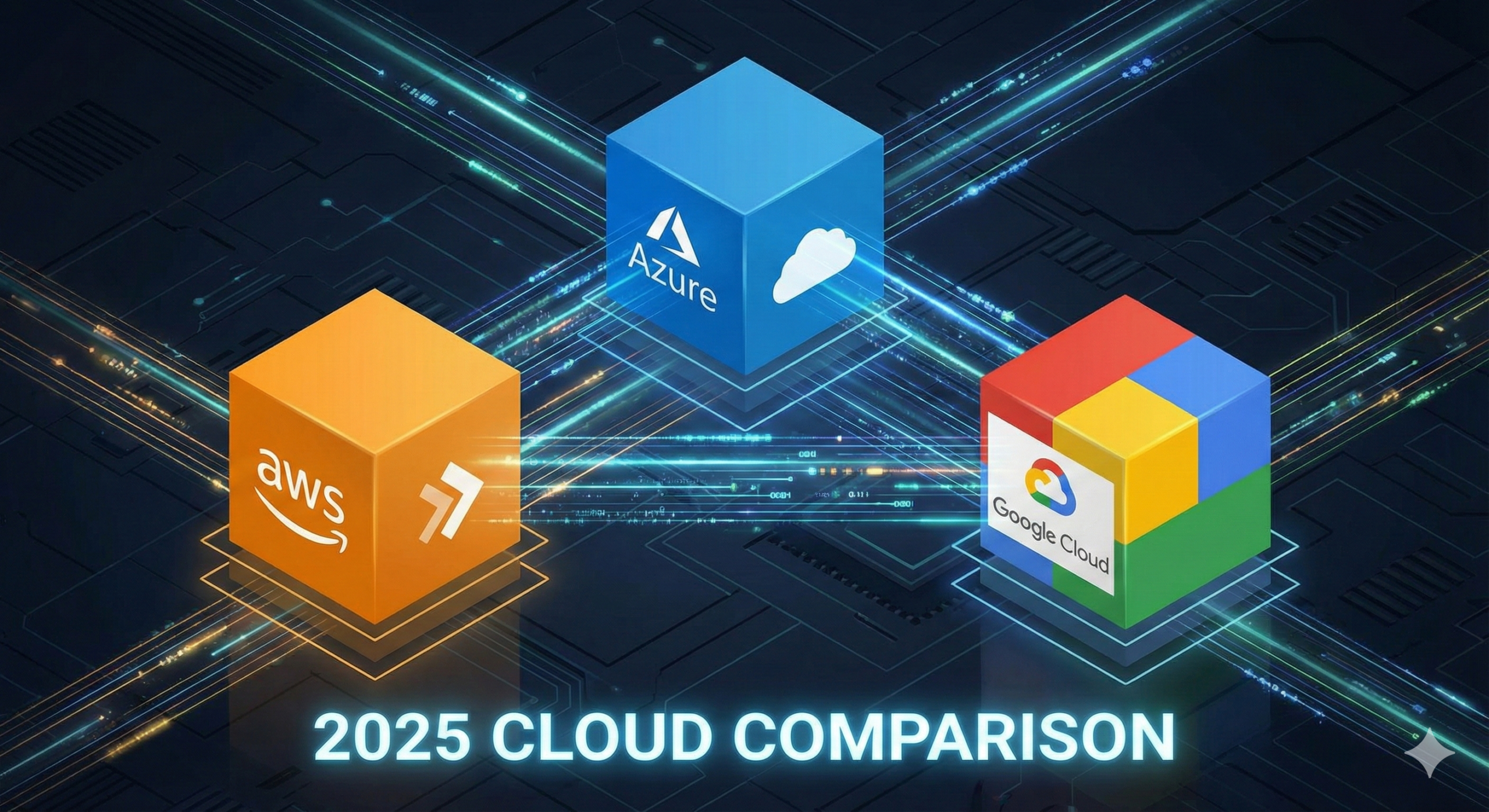
| Provider | Market Share Position | Core Strength | Strategic Focus |
| AWS | Clear Leader (30%+) | Depth and Maturity. Unmatched service breadth and feature depth. | Enterprise migration, e-commerce, and high-scale applications. |
| Microsoft Azure | Strong Second (20%+) | Hybrid & Enterprise Integration. Seamless connection to existing Microsoft ecosystems (Windows Server, SQL Server). | Regulated industries, hybrid cloud, and traditional enterprises. |
| Google Cloud (GCP) | Focused Third (10%+) | Data, AI/ML, and Open Source. Best-in-class data analytics and machine learning services. | Digital natives, data scientists, and specialized AI workloads. |
2. Deep Dive: Architectural Philosophy
A. Amazon Web Services (AWS)
AWS operates on the philosophy of offering the customer the maximum number of building blocks. If you need a service, AWS already has 3 different ways to accomplish it.
- Pro: Unmatched service count (300+). If you can think of it, AWS offers it.
- Con: Service Overload. The sheer number of options can be overwhelming, leading to configuration complexity and potential security missteps if not governed correctly.
B. Microsoft Azure
Azure’s philosophy is integration and familiarity. It is built to be the natural extension of the enterprise data center.
- Pro: Hybrid Cloud Dominance. Azure Arc allows customers to manage resources both on-premise and in the cloud using a single control plane. Essential for organizations with legal requirements to keep some data local.
- Con: Often requires deep integration with Microsoft licensing, which can be costly and lead to vendor lock-in.
C. Google Cloud Platform (GCP)
GCP is built on the infrastructure that powers Google’s core products (Search, YouTube). Its architecture is designed for immense scale and sophisticated data pipelines.
- Pro: Open Source Focus. Strong support for Kubernetes (Google invented it) and streamlined infrastructure services. Best global private network backbone.
- Con: Service Gaps. While core services are world-class, the breadth of niche services (e.g., specific compliance services or low-demand region availability) is still catching up to AWS.
3. Pricing and Cost Management
Pricing is the single most confusing factor. All three use pay-as-you-go models, but their discount structures differ.
AWS
- Model: Highly complex. Best deals come from Reserved Instances (RIs) or Savings Plans, which require a 1- or 3-year commitment.
- Cost Advantage: Excellent spot pricing (using unused compute capacity) for non-critical, interruptible workloads.
Azure
- Model: Highly transparent integration with existing Microsoft volume licensing agreements. If you already pay Microsoft for Windows/Office, you get significant discounts (Azure Hybrid Benefit).
- Cost Advantage: Automatic sustained-use discounts—the longer a machine runs, the cheaper it gets (unlike AWS, this often doesn’t require upfront commitment).
GCP
- Model: The most modern and user-friendly. Automatically applies deep discounts for sustained usage (Committed Use Discounts).
- Cost Advantage: Sub-second billing (you only pay for what you use, down to the second). Best value for short-lived, burstable workloads like serverless functions.
Strategic Conclusion: AWS is cheaper if you have a massive, predictable workload and can commit upfront. GCP is cheaper and simpler for variable, burstable, and data-centric workloads.
4. Specialized Services Deep Dive
A. Data Analytics and Machine Learning (ML)
- GCP is the King. Services like BigQuery (serverless, petabyte-scale data warehouse) and Vertex AI (unified ML platform) are arguably the industry standard. Ideal for data scientists and companies whose core product is driven by ML models.
- AWS is Strong. Offers Sagemaker, a robust and fully featured platform for ML model development, and Redshift for data warehousing.
- Azure is Excellent for BI. Its strength is the seamless integration of services with familiar tools like Power BI and SQL Server.
B. Serverless and Compute
- AWS is the Pioneer. Lambda (serverless compute) is the most mature, with the largest ecosystem and most integrations.
- GCP is the Value Leader. Cloud Functions and Cloud Run (containerized serverless) offer the best price and latency for short-lived functions.
- Azure is the Hybrid King. Azure Functions and Azure App Service are excellent for lifting and shifting existing enterprise applications to a cloud-managed environment.
C. Container Orchestration (Kubernetes)
- GCP is the Innovator. Google Kubernetes Engine (GKE) is considered the most stable, secure, and advanced managed Kubernetes service because Google invented Kubernetes.
- AWS is the Popular Choice. Elastic Kubernetes Service (EKS) has the largest market share due to the overall popularity of AWS.
- Azure is Solid. Azure Kubernetes Service (AKS) integrates well with Azure’s ecosystem.
5. Strategic Decision Framework (When to Choose Which)
Choose AWS if:
- You Need Depth and Breadth: Your application requires an obscure or highly specific service (e.g., quantum computing access, specialized IoT messaging).
- You are Building a Truly Cloud-Native Application: You want maximum flexibility and access to the largest third-party ecosystem.
- Your E-Commerce is High-Scale: AWS is the historical favorite for retail and large-scale web traffic.
Choose Microsoft Azure if:
- You are a Traditional Enterprise: You run SQL Server, Windows Server, and rely heavily on Active Directory (Azure AD).
- You Need Hybrid Cloud: Your regulatory environment requires keeping some workloads or data on-premise (via Azure Stack/Arc).
- You Need Enterprise Sales & Support: You require the familiarity and established vendor relationship of a Microsoft contract.
Choose Google Cloud Platform (GCP) if:
- Your Core Business is Data and AI: You require the most advanced tools for machine learning, data warehousing, and real-time data analysis.
- You Need Best-in-Class Kubernetes: You are building container-first microservices architecture and prioritizing operational simplicity.
- You are a Digital Native/Startup: You prioritize speed of deployment and cost efficiency for variable, high-growth workloads.
Conclusion: The Era of Multi-Cloud is Here
In 2025, the most mature organizations rarely choose just one vendor. They adopt a Multi-Cloud Strategy, leveraging the best of each platform:
- AWS for core application hosting and global reach.
- GCP for specialized AI/ML and data pipelines.
- Azure for integrating with legacy enterprise systems and Microsoft collaboration tools.
The strategic imperative is not to fear multi-cloud complexity but to use containerization (Kubernetes) and serverless technologies to keep your applications portable. The best cloud platform for your business is the one that minimizes your operational friction while maximizing your competitive edge, whether that is cost, speed, or specialized AI capability.