In digital marketing, every visitor has a potential value—but only if you guide them through the entire customer journey correctly. This journey is known as the marketing funnel, and it is responsible for transforming anonymous visitors into engaged leads, and eventually into loyal paying customers. Unfortunately, many small businesses fail to maximize revenue simply because their funnel is incomplete, inefficient, or poorly automated.
Traditionally, marketing funnels require a massive amount of work. You must create content, segment users, send emails, personalize messages, track behavior, and optimize performance. For years, only large organizations could afford to build complete funnel systems because they required marketing departments, developers, and data analysts.
In 2025, that era is over.
Thanks to generative AI tools like ChatGPT and Gemini, combined with automation platforms such as Mailchimp, small teams can now build powerful marketing systems that rival enterprise setups. AI replaces repetitive work, speeds up content production, and personalizes communication at scale. Mailchimp handles delivery, logic, segmentation, and analytics.
Together, these tools allow one marketer to manage thousands of customer journeys automatically.
This guide breaks down exactly how to automate your marketing funnel step-by-step using ChatGPT and Mailchimp. You will not only understand the theory but also how to implement it practically across the awareness, nurturing, and conversion stages.
Understanding the Funnel Automation Strategy
Before discussing tools, it is essential to understand how automation transforms each stage of the funnel.
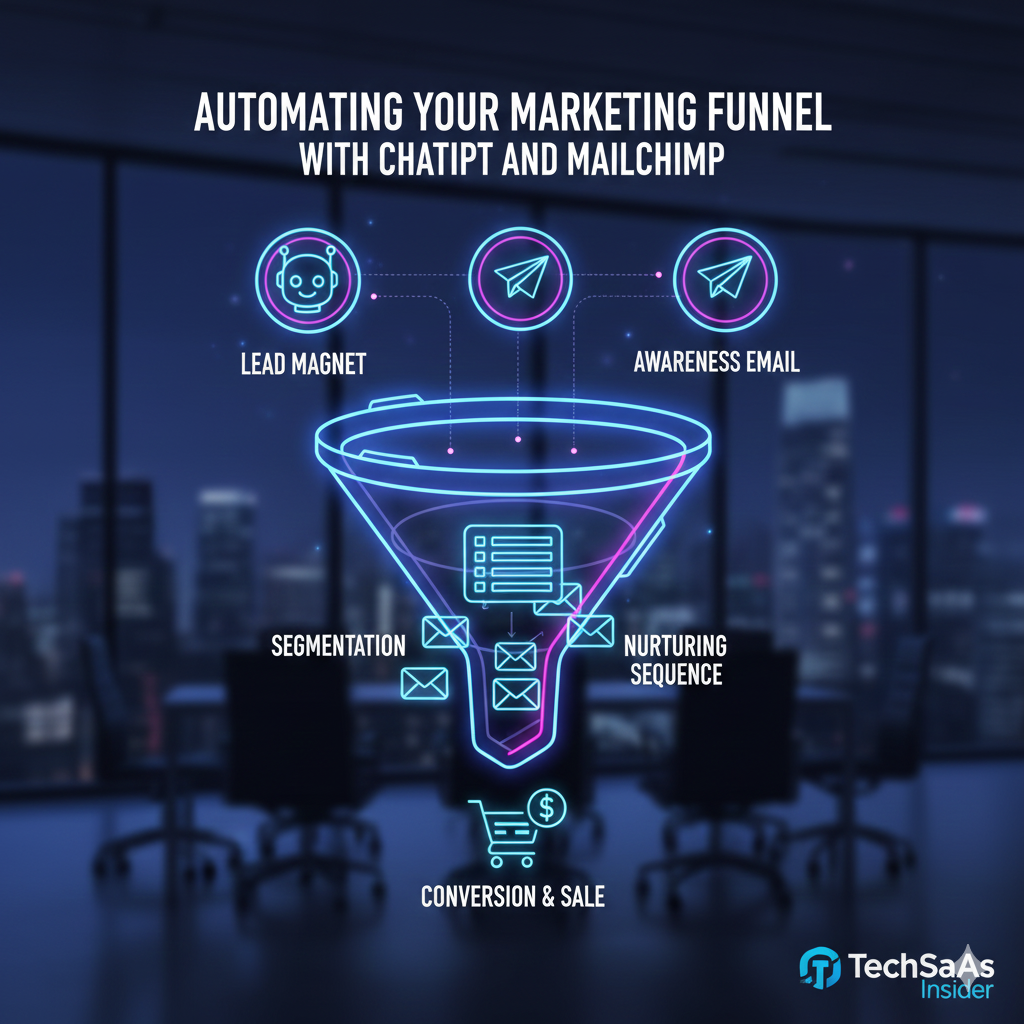
A modern automated funnel consists of:
- Content creation at scale (AI)
- Behavioral segmentation (Mailchimp)
- Triggered communication (Mailchimp)
- Personalization logic (AI)
- Data-driven optimization (Mailchimp + AI)
AI handles the content.
Mailchimp handles the delivery.
Your strategy connects everything.
Phase 1: Awareness and Lead Capture
The top of the funnel focuses on attracting attention and converting visitors into email subscribers or leads.
AI-Generated Lead Magnets
A website without lead magnets is losing value every day. AI allows you to generate lead magnets faster than ever.
Using ChatGPT or Gemini, you can instantly create:
- eBooks
- Checklists
- Whitepapers
- Tutorials
- Templates
- Industry guides
- Workbooks
- Case studies
Instead of hiring writers or spending weeks producing PDFs, you generate content in hours. By prompting the AI correctly, you can produce professional lead magnets tailored to your niche.
Once completed, upload your lead magnet into Mailchimp’s form builder or landing page feature and connect it to your email list. Every download automatically becomes a lead.
Automated Welcome Sequence
Your first emails determine whether a lead becomes a customer or unsubscribes.
AI can assist in writing high-quality onboarding sequences including:
- Welcome emails
- Delivery emails
- Brand storytelling messages
- Education emails
- Qualification emails
Here’s an example workflow:
Day 0 – Welcome Email
Deliver the lead magnet and introduce your brand.
Day 2 – Value Email
Provide a case study or educational insight.
Day 4 – Qualification Email
Ask one important question about their business or need.
Each email can be generated by the AI with tone control and personalization suggestions.
Mailchimp automates the flow once the lead signs up.
Phase 2: Nurturing and Segmentation
This is where most businesses fail. They send emails. But they don’t segment.
Behavioral Segmentation with Mailchimp
Mailchimp allows you to tag, group, and filter your audience based on:
- Link clicks
- Page visits
- Email opens
- Purchase behavior
- Forms completed
- Lead magnet chosen
Instead of sending the same content to everyone, you create dynamic segments.
For example:
- Segment A: Interested in AI tools
- Segment B: Interested in cybersecurity
- Segment C: Interested in marketing software
- Segment D: Inactive subscribers
- Segment E: High engagement users
AI-Powered Nurturing Content
Once segmented, AI allows you to personalize content for each segment.
Instead of generic emails, the AI writes messages that speak directly to a person’s problem.
For example:
A cybersecurity lead receives:
- Educational emails about risk
- Best practices
- Case studies
- Awareness content
A CRM lead receives:
- Productivity tips
- Comparison guides
- Optimization strategies
- Automation examples
This makes the communication relevant and valuable.
AI allows you to scale personalization without writing 50 different campaigns manually.
Dynamic Engagement Triggers
Mailchimp enables triggers that activate based on behavior.
For example:
- If a user clicks a CRM link → Send follow-up campaign
- If a user opens three emails but does not click → Send re-engagement sequence
- If user does not open for 30 days → Send win-back campaign
- If visitor views pricing page → Add sales trigger
- If user requests demo → Start conversion flow
AI can generate all the email content for each path.
Instead of guessing, the system reacts.
Phase 3: Conversion and Sales Automation
At this stage, leads already trust you. They just need confidence.
Abandoned Cart Automation
Mailchimp detects when:
- A user abandons checkout
- Stops a trial signup
- Quits a form
- Leaves product pages repeatedly
AI writes recovery emails that:
- Address hesitation
- Reduce uncertainty
- Reassure
- Encourage
- Offer help
Instead of generic reminders, the AI writes emotionally intelligent messages.
For example:
“Not sure if this is right for you? Here’s how companies like yours solved the same problem.”
AI Testimonials and Social Proof
Trust closes deals.
Using AI, you can generate:
- Personalized testimonial summaries
- Industry-specific stories
- Soft social proof narratives
- Customer success highlights
Mailchimp inserts these into final-stage emails dynamically.
A freelancer sees testimonials from freelancers.
An agency sees agency success stories.
A startup sees startup results.
This micro-personalization dramatically increases conversion.
Best Practices for Implementation
1. Protect Your Brand Voice
Always train AI with:
- Your style guide
- Real email samples
- Existing copy
- Brand values
Never let AI create blindly.
2. Always Review Before Sending
AI is fast, not perfect.
You must:
- Validate facts
- Adjust tone
- Remove exaggerated claims
- Protect compliance (GDPR, consent, etc.)
3. Create Real Value
The fastest way to kill engagement is spam.
Teach more than you sell.
Help before you promote.
Educate before you pitch.
Common Mistakes to Avoid
- Automating without segmentation
- Sending generic emails
- Ignoring analytics
- Not testing subject lines
- Not cleaning lists
- Over-emailing
- Forgetting unsubscribe experience
- Not measuring conversion behavior
Automation works only if optimized.
Why This Strategy Wins in 2025
In 2025, marketing is no longer about louder messages.
It’s about:
- Smarter timing
- Relevant content
- Personalized intent
- Behavioral intelligence
AI levels the playing field.
The smallest teams now outperform large organizations if they use automation intelligently.
This combination of ChatGPT and Mailchimp builds a system that never sleeps.
It attracts, nurtures, and converts without human intervention.
Final Conclusion
Marketing funnels once required a team.
Now they require a system.
With ChatGPT and Mailchimp, you build that system with precision.
AI writes.
Mailchimp delivers.
Customers convert.
You focus on strategy.
The system does the rest.