Artificial Intelligence is no longer an experimental technology reserved for large corporations. In 2025, AI has become one of the most powerful engines of growth for small businesses worldwide. The idea that only enterprises with large budgets and technical teams can benefit from AI is a dangerous myth. Today, even a one-person business can leverage artificial intelligence to automate tasks, analyze data, communicate better with customers, and scale its operations far beyond traditional limits.
For modern entrepreneurs, the question is no longer “Should I use AI?” but “How fast can I integrate it into my business?” Every month without automation leads to lost efficiency, missed opportunities, and increasing pressure from competitors who are already using smart systems to work faster and smarter.
AI does not replace business owners; it replaces friction. It removes repetitive tasks, accelerates decision-making, and frees up time for strategy and creativity. Whether you operate an e-commerce store, a service business, or a local company, implementing AI tools can significantly reduce costs and multiply output.
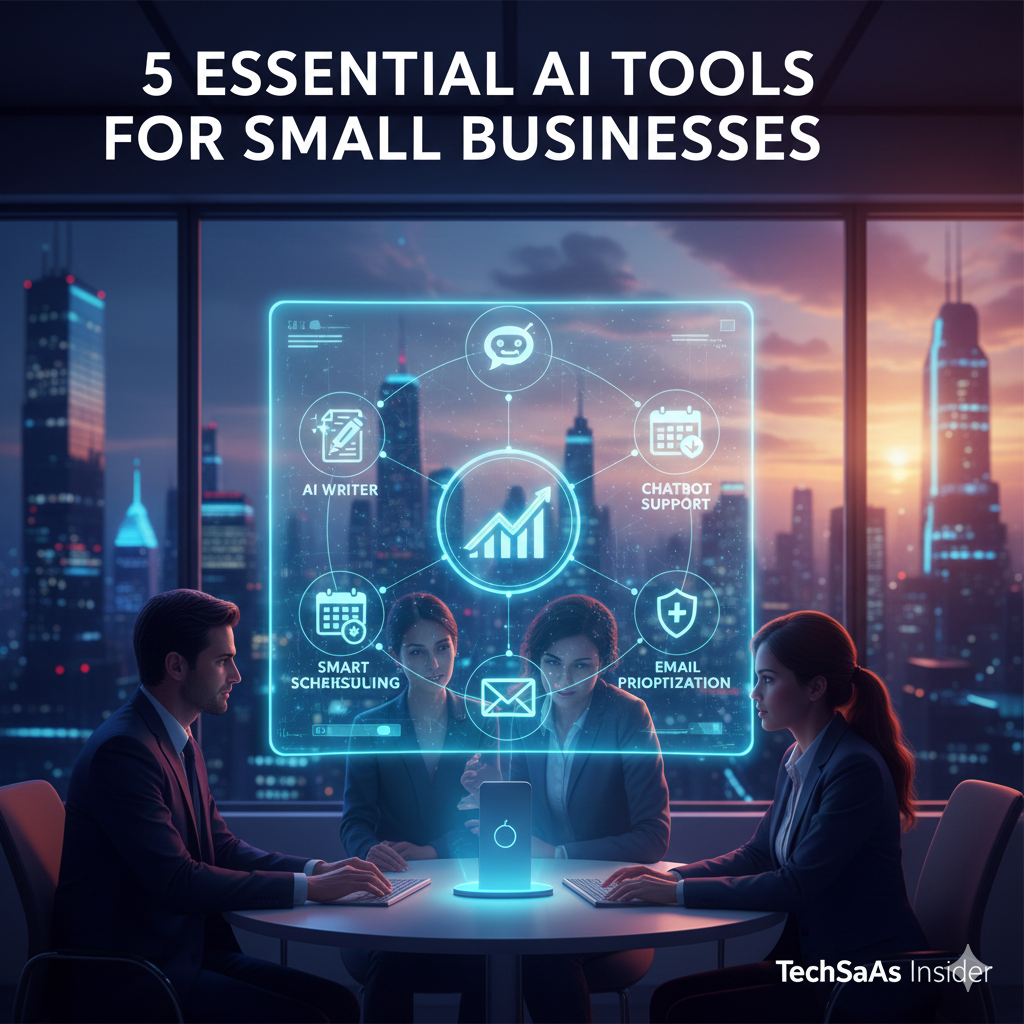
In this complete guide, we explore the five most important AI tools that small businesses must adopt in 2025. You will not find abstract theory here — only practical tools that work, explained clearly and realistically. By the end, you will understand exactly how artificial intelligence can transform your operations and why delaying adoption is one of the biggest mistakes a business can make today.
1. AI Content Writing Tools for Marketing and SEO
Content creation is one of the biggest challenges for small businesses. Search engines reward websites that publish useful, well-structured and frequently updated content. Unfortunately, writing high-quality articles, product descriptions, ads, and newsletters requires both time and skill. Many small business owners simply cannot publish enough content to compete online.
This is where AI writing tools make a dramatic difference.
AI content writers enable businesses to generate blogs, web copy, and promotional content in minutes instead of days. Instead of starting from a blank page, the AI receives instructions about your topic, tone, and target audience. It then produces a structured draft that you can edit, refine, and publish.
These tools can:
- Create SEO-optimized blog posts
- Write landing page copy
- Generate product descriptions for e-commerce
- Create advertising text for Google and social media
- Rewrite content in different tones and formats
- Produce emails and newsletters quickly
- Improve grammar and readability automatically
With AI assistance, small teams can publish as frequently as large companies. This consistency directly increases search engine rankings, website authority, and customer trust.
However, it is important to understand that AI is not a replacement for human thinking. It simply handles execution faster. You still control the strategy, voice, and business direction. AI removes the heavy labor.
From a business perspective, this means better visibility, lower content costs, and faster launch cycles. Instead of hiring multiple writers, small companies can reinvest savings into growth.
2. AI Chatbots for Customer Support and Sales Automation
Customer support can easily become overwhelming for small businesses. Clients expect immediate replies, real-time updates, and smooth communication. Unfortunately, most small companies cannot afford 24-hour support teams.
AI chatbots solve this problem completely.
Modern chatbots are no longer robotic scripts. They understand customer questions, handle conversations naturally, and provide accurate answers automatically. A well-configured chatbot can manage most customer requests without human involvement.
Chatbots can:
- Answer frequently asked questions
- Provide order updates
- Offer basic troubleshooting
- Recommend products
- Capture leads
- Route complex issues to humans
- Translate languages
- Collect customer information
One of the biggest advantages is availability. AI never sleeps. It handles customers when you are away, during holidays, or outside business hours.
Businesses that implement chatbots often notice immediate improvements:
- Faster response times
- More completed purchases
- Fewer abandoned carts
- Lower workload for teams
- Higher customer satisfaction
- Stronger brand trust
Customers feel supported, and businesses regain time.
Instead of hiring support agents, businesses hire software. The result is scalable service without constant cost increases.
3. AI Scheduling and Appointment Automation
Time management destroys productivity when handled manually.
Emails, phone calls, missed connections, rescheduled meetings… this wastes massive amounts of time in sales and customer service operations.
AI scheduling tools eliminate that chaos.
Instead of negotiating schedules, clients get a single link. They select an available time automatically synchronized with your calendar. The system handles confirmation, reminders, and rescheduling.
These systems offer:
- Calendar syncing
- Automatic reminders
- Video call generation
- Time-zone detection
- Integration with CRM software
- Booking analytics
This means better organization and higher attendance rates.
From a customer perspective, the experience feels smooth and professional. From a business perspective, fewer delays and fewer mistakes mean faster sales cycles and less friction.
If you measure time as money, scheduling automation is one of the highest-return tools available.
4. AI Email Management and Productivity Optimization
Email overload has become one of the biggest productivity killers in modern business.
Important emails get buried under marketing newsletters, promotions, spam, and system alerts. Business owners waste hours scanning inboxes rather than making decisions.
AI email tools change that reality completely.
Instead of filtering emails manually, AI systems analyze your behavior and organize your inbox dynamically. They learn what matters to you and prioritize accordingly.
Functions include:
- Smart inbox sorting
- Priority detection
- Spam filtering
- Automated categorization
- Response suggestions
- Follow-up reminders
The result is a clean inbox that shows only what matters.
This increases focus and eliminates distraction. Employees answer fewer emails faster and with higher quality.
Instead of becoming an email manager, you become a business operator again.
5. AI Accounting and Financial Forecasting
Most small businesses fail financially not because they lack customers, but because they mismanage cash flow.
Financial blindness is deadly.
AI accounting tools turn bookkeeping into business intelligence.
Instead of old spreadsheets and delayed reporting, AI systems provide:
- Automated categorization
- Expense tracking
- Cash flow projections
- Revenue forecasting
- Fraud detection
- Budget optimization
- Financial trends analysis
With AI, you no longer react to problems after they happen — you see them coming.
For example, AI can predict inventory shortages, identify unnecessary subscription costs, and forecast future shortfalls. Businesses move from survival mode to strategic operation.
Financial awareness becomes real-time, not theoretical.
Final Thoughts: Why AI Adoption is No Longer Optional
AI is not a luxury.
It is infrastructure.
The same way electricity, internet, and mobile devices became essential, artificial intelligence is now foundational technology.
The cost of AI adoption is tiny compared to the cost of inefficiency:
- Lost leads
- Missed emails
- Manual mistakes
- Slow customer service
- Poor planning
- Inconsistent marketing
- Unreliable data
Your competitors are adopting AI now.
The question is not whether AI will change business.
The question is whether your business will survive without it.
Small businesses that embrace AI operate faster, communicate better, and make smarter decisions.
Technology no longer favors size.
It favors intelligence.